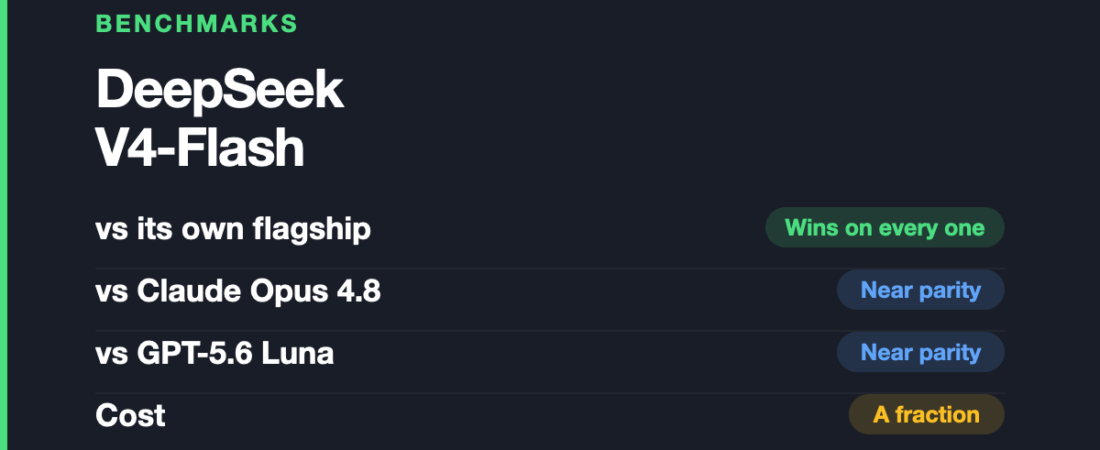
DeepSeek pushed the official version of its V4-Flash model live on July 31 — and the numbers are a little awkward for the company’s own flagship. Flash, the “cheap and fast” model in the lineup, now beats DeepSeek’s own top-tier V4-Pro on every one of the nine agent and coding benchmarks the company has published. Not close on most of them, either. That’s the kind of result that normally gets buried in a footnote; DeepSeek put it in the headline.
Here’s what’s actually in the release, what it’s being compared against, and where it realistically fits if you’re choosing a model for coding or agent work.
What actually shipped
The build is tagged V4-Flash-0731 — DeepSeek dates its releases rather than naming them, so “0731” just means July 31. Under the hood it’s a Mixture-of-Experts model: 284 billion parameters total, but only 13 billion of those get activated per request, which is the whole reason it can be this fast and this cheap. It also carries a 1-million-token context window, so genuinely large codebases or document sets fit in a single prompt.
The interesting part isn’t the spec sheet, though — it’s that this is a retrained Flash, not a smaller distillation of V4-Pro shipped for convenience. DeepSeek trained it separately, and it ended up ahead of its own bigger sibling on agentic and coding tasks. That’s not supposed to happen with a “lite” model, and it’s the reason this release is getting attention beyond the usual benchmark-chart churn.
The numbers, compared
Two benchmarks tell most of the story. Terminal Bench 2.1 measures complex command-line agent work — the kind of multi-step task where a model has to plan, execute, and recover from its own mistakes. Agents’ Last Exam is a harder, broader agentic benchmark designed to separate models that are genuinely capable from ones that just look good on narrower tests.
| Model | Terminal Bench 2.1 | Agents’ Last Exam |
|---|---|---|
| DeepSeek V4-Flash-0731 | 82.7 | 25.2 |
| DeepSeek V4-Pro-Preview (own flagship) | 72.1 | — |
| Claude Opus 4.8 (Anthropic) | 85.0 | 25.7 |
Read that Terminal Bench row again: Flash scores 82.7, and DeepSeek’s own Pro-Preview scores 72.1 — a ten-point gap, in favor of the smaller, cheaper model. Against Claude Opus 4.8, one of the most capable coding models available right now, Flash is within 2.3 points. On Agents’ Last Exam it’s within half a point of Opus 4.8. This isn’t a budget model that’s “good enough” — on these two tests specifically, it’s in the same tier as frontier models that cost several times more per token.
The other comparison worth knowing about is against OpenAI’s GPT-5.6 “Luna.” On the Artificial Analysis Intelligence Index — a broad score covering reasoning, knowledge, math, and coding — Flash scores 50 against Luna’s 51. Essentially tied. The gap that matters is price: DeepSeek’s model runs about 60% cheaper per task than GPT-5.6 Luna, and that’s after accounting for OpenAI’s own 80% price cut on Luna. DeepSeek isn’t winning on raw intelligence here — it’s winning on what you pay for intelligence that’s basically equivalent.
Why it’s this cheap
The published pricing is $0.14 per million input tokens and $0.28 per million output tokens through DeepSeek’s own API. The number that actually explains the cost advantage, though, is the cache pricing: repeated context costs $0.003 per million tokens on a cache hit — a 98% discount, compared to the roughly 90% cache discount that’s become standard among competitors. If your workload reuses a lot of context (long conversations, large codebases you’re iterating on, repeated system prompts), that extra 8 points of discount compounds fast.
It’s also just a leaner model at inference time. DeepSeek reports Flash using 12% fewer tokens than its predecessor to reach the same answers, and on GDPval — a benchmark for complex office and knowledge work — it jumped from 1,189 to 1,559 Elo over the previous generation. That’s not a marginal step; that’s the kind of jump that changes which tasks a model is actually usable for.
Should you use it?
If you’re doing agentic coding work — the kind where a model is calling tools, editing files, running commands, and correcting itself over multiple steps — this is now a legitimate alternative to models costing several times more, not just a fallback for when budget is tight. The Terminal Bench score alone puts it ahead of plenty of models people are still defaulting to out of habit.
Where it’s less of a slam dunk: DeepSeek’s models are still developed and hosted primarily out of China, which matters for teams with data residency or compliance requirements, and third-party evals on brand-new releases tend to firm up over the following weeks as more people put it through their own workloads rather than the vendor’s chosen benchmarks. If you’re deciding today, treat the numbers above as a strong signal, not gospel — and if your use case is genuinely latency- or compliance-sensitive, wait a cycle for independent confirmation.
For everyone else, particularly anyone running high-volume agent workloads where the per-token cost actually shows up on an invoice: this is worth testing against whatever you’re using now. The gap DeepSeek is closing — near-frontier performance at a fraction of the cost — is exactly the gap that decides which model teams standardize on once the novelty wears off.
Sources
- Tech Times — DeepSeek Retrained V4-Flash Beats Its Flagship Pro on Nine Agent Benchmarks
- The Decoder — New DeepSeek Flash model matches OpenAI’s GPT-5.6 Luna at roughly 60% lower cost
- Artificial Analysis — DeepSeek V4 Flash 0731 Intelligence, Performance & Price Analysis
- OpenRouter — DeepSeek V4 Flash pricing and specs