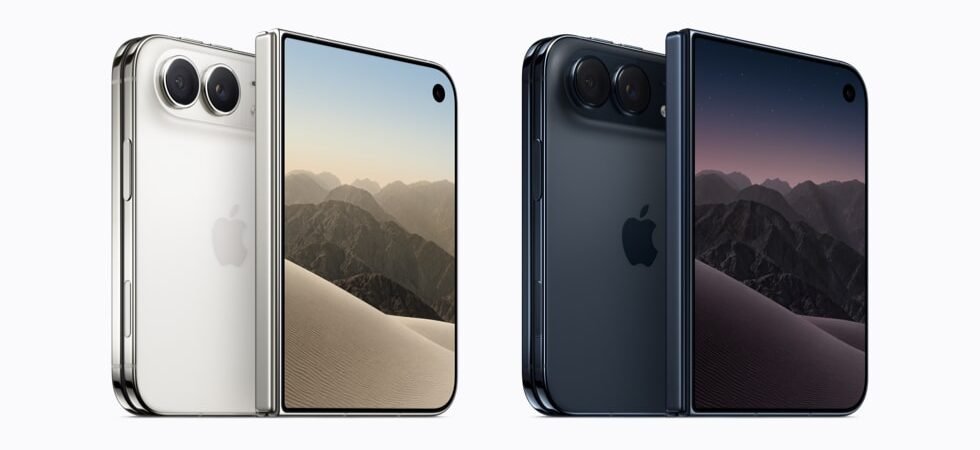
Apple’s first foldable isn’t really about folding. It’s about surfaces — how titanium feels, how a crease disappears, and how matte can still feel premium. That’s why industrial designers should pay attention.
On September 9, 2026, Apple finally showed its hand with the iPhone Duo. Starting at $1,999, pre-orders October 16, on sale October 23. Book-style fold, 5.4-inch outer Super Retina XDR that feels like a passport in your pocket, opening to a 7.6-inch inner panel — Apple’s biggest iPhone screen ever and its thinnest chassis when open at 5.2 mm.
We’ve handled a lot of foldables that felt like prototypes with a price tag. The Duo is different. Not because the typology is new — Samsung, Google and Motorola got there years ago — but because Apple treated it like a precision optical-mechanical system. If you design physical products, here’s what actually matters.
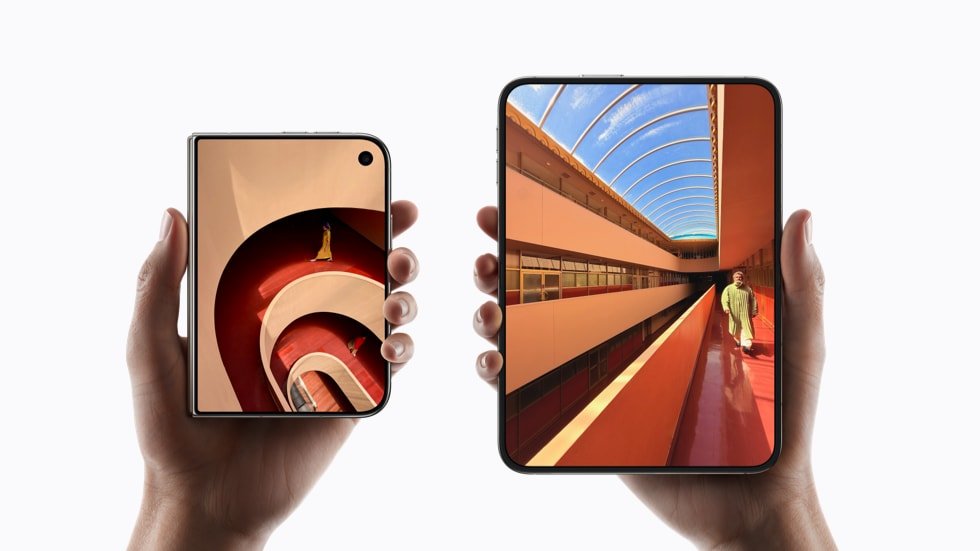
Folded 5.4-inch outer, unfolded 7.6-inch inner. Same aspect ratio, so content scales without the weird stretch. Image via Apple Newsroom.
What we verified
Specs are from Apple’s September 9 announcement, hands-on impressions are from journalists who touched it at Apple Park — not long-term users. The Duo hasn’t shipped yet, so anything about durability after 10,000 folds is still educated guesswork.
- Form factor confirmed: 5.4-inch outer, 7.6-inch inner, 5.2 mm thin open, ~117.8 × 84.1 × 11.3 mm closed, 254 g. Touch ID in the side button, no Face ID.
- Materials confirmed: Grade 5 titanium frame, polished mirror finish with high recycled content. Hinge cover 3D-printed from 100% recycled titanium, microblasted. Ceramic Shield 2 outside (Apple claims 3x better scratch resistance), Ceramic Shield on the back. IP68 to 6 meters for 30 minutes.
- Display stack confirmed: Custom nano-texture polymer cover, claimed up to 40% stiffer than industry alternatives, multi-layer lamination, high-strength glass sandwiching the OLED, viscoelastic adhesives, titanium backing plate.
- Crease impressions converge: Still there if you hunt for it, far less visible head-on than earlier foldables. More on that below.
What Apple hasn’t proven yet: how that nano-texture holds up to keys, sand, and two years of thumb swipes. Keep that in mind before you spec something similar.
1. The enclosure: Grade 5 titanium, but restrained
Forget shiny for shiny’s sake. The Duo frame uses Grade 5 titanium polished to a mirror, but the color story is almost boring on purpose — Star White and Night Sky only.
That’s a classic CMF move. When your manufacturing is expensive, you let the material do the talking. No gradient, no hero color to hide sink marks. Just titanium’s optical qualities, tight radii, and rounded edges that actually help you pry the thing open.
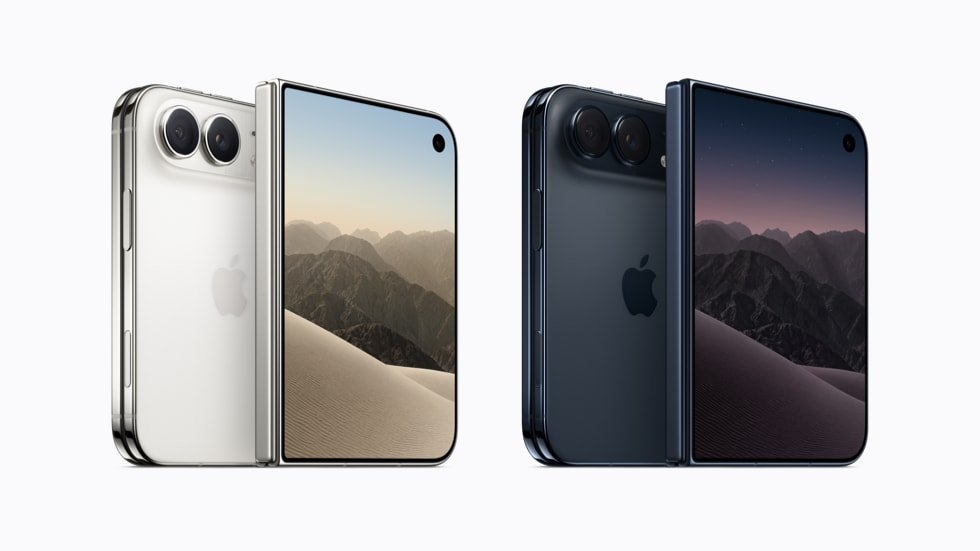
Star White and Night Sky. Limited palette, maximum focus on surface quality. Image via Apple Newsroom.
Two details designers will argue about over coffee:
- Asymmetric corners. More rounded on the outer edge when open, squarer on the hinge side. Elegant to some, unbalanced to others. Functionally, it helps grip and pocketability in that short-wide passport proportion.
- Weight vs. rigidity. At 254 g closed, it’s chunkier than a Galaxy Z Fold 8. Reviewers split here — some call it substantial, others call it reassuringly solid. If you’ve ever modeled a thin-wall enclosure in Fusion 360 or SolidWorks, you know that trade-off intimately.
And yes, IP68 to 6 meters. For a foldable with a 100+ part hinge, that’s genuinely hard. Hinges hate seals.
2. The hinge: 100+ parts you’re not supposed to notice
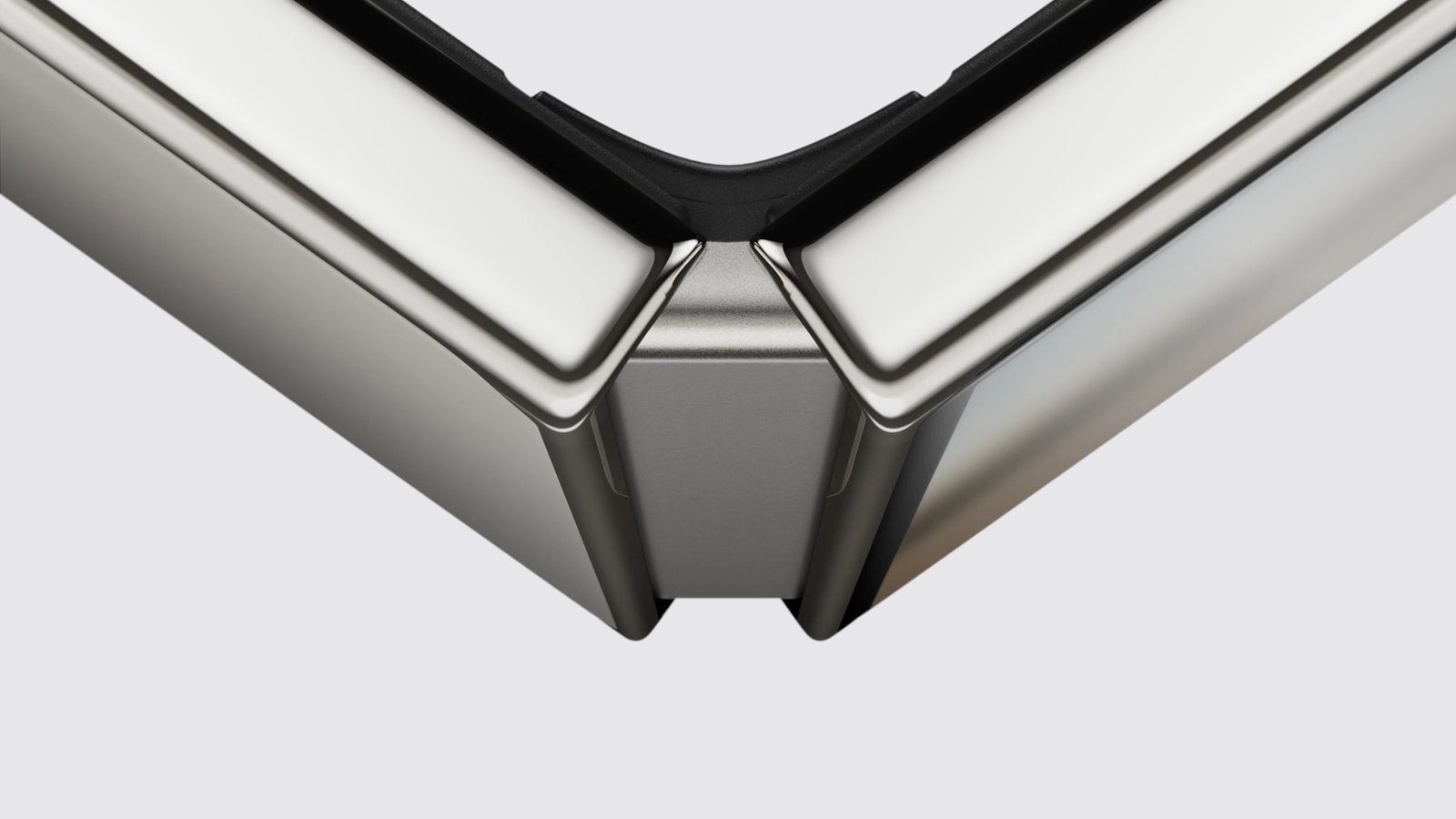
Precision hinge with carbon-fiber reinforcement and 3D-printed titanium cover. Image via Apple.
Apple says the hinge is more than 100 components with carbon-fiber reinforcement plates, and that hinges are algorithmically matched to housings. Translation: they bin and pair parts like camera lenses, not like phone hinges.
The cover itself is 3D-printed from 100% recycled titanium with a microblasted finish — matte against the polished frame. That’s smart CMF contrast: shiny where your eye goes, matte where your fingers go and where scratches would show.
Hands-on reports all mention the same thing: solid action, no wobble, satisfying detents for half-open poses. For pose-aware UI to work — hands-free FaceTime, tabletop video, flex-mode multitasking in iOS 27 — that torque curve has to be consistent. If you prototype hinges, you know how hard “smooth but stays put” is.
3. The real story: nano-texture as surface engineering
This is the part to study, even if you never design a phone.
The inner display isn’t just “matte.” It’s a system:
- Custom nano-texture polymer cover layer, 40% stiffer claim, with scratch-resistant coating
- High-strength glass layers sandwiching the OLED
- Viscoelastic adhesives that let layers glide “like book pages” instead of stretching and buckling
- Titanium plate backing for flatness
- Per-unit correction: confocal laser scanning maps topography, then up to 25 microlayers of photopolymer are 3D-printed to correct waviness
Read that last one again. Apple is scanning every unit and printing correction layers to kill residual waviness. That’s semiconductor / optics thinking applied to a consumer display. If you render CMF in KeyShot or Blender, imagine telling a client you laser-map each part and print 25 correction layers. That’s the bar now.
Visually, the effect is paper-like. Gizmodo nailed it: “looks like paper; it’s not reflective at all.” It scatters light, kills glare, and — crucially — lowers crease salience. The fold is still physically there. You just don’t see it head-on.
So is the crease gone?
Short answer: no. Honest answer: it’s the least annoying crease we’ve seen described on a first-gen foldable.
- TechRadar’s Lance Ulanoff: “I can feel it with my finger, but cannot see it.” Called the matte finish unusual for a foldable and “generally lovely.”
- Tom’s Guide: “barely” visible, “you can’t even feel it,” inner display “breathtaking.”
- Gizmodo / Notebookcheck: visible at angles and under raking light, comparable or slightly better than Galaxy Z Fold 8, far better than older folds.
Head-on, it largely disappears. Tilt it under spotlights — like an Apple Park demo table — and you’ll find it. The open question is cycle 5,000, not demo day. Viscoelastic glide adhesives should help, but no journalist has lived with one yet.
4. The compromises Apple chose (and why they matter for ID)
Every thin product is a list of no’s. Here’s Duo’s:
- No Face ID. Side Touch ID instead. The under-display inner FaceTime camera stays hidden to keep the panel uninterrupted. Packaging wins over biometrics.
- No dedicated long telephoto. Dual 48MP Fusion main + 48MP ultra-wide, with 2x crop from the main. At 5.2 mm open, a periscope stack just doesn’t fit without a huge plateau. Apple instead made the full-width camera plateau double as anti-wobble — the phone sits flat on a table. Nice save.
- No day-one Pencil. Apple says Pencil with USB-C comes later this year for both displays. If you’re designing for stylus, that delay tells you tolerance / digitizer tuning wasn’t ready for launch.
- Passport proportions divide people. Short and wide is great one-handed closed, odd for video or narrow apps open. Same aspect ratio inner/outer helps continuity, but expect designers to either love it or hate it.
None of these are accidents. They’re thickness and hinge-volume constraints made visible. That’s worth showing to students: great industrial design is often what you leave out to keep 5.2 mm flat.
What industrial designers should actually take away
Forget “foldable iPhone” hype. Steal these four ideas:
1. Treat the display as a mechanical-optical stack, not a part. Stiffness, glide, backing flatness, per-unit laser correction — Apple solved crease visibility with manufacturing, not just materials.
2. Use matte strategically. Gloss reads premium in renders. Matte hides real-world sins (glare, fingerprints, waviness) and creates tactile differentiation. Test your CMF under raking light, not just studio HDRI.
3. Design the joint as seriously as the form. Algorithmic hinge-to-housing matching, carbon reinforcement, printed titanium cover — the hinge is the product here. If your product has a moving joint, budget tolerance work early in Rhino or Fusion, not right before tooling.
4. Limit color to prove quality. Two restrained finishes force you to nail parting lines, grain, and edge breaks. If your prototype needs a loud color to look good, your surfaces aren’t there yet.
Try this on your next housing: prototype one variant with a micro-textured matte film over gloss, review it outdoors at noon and under a single downlight at night, and do a blind touch test. You’ll learn more about perceived quality than another render iteration.
The practical verdict
The iPhone Duo is a reference point for foldable surface engineering, not proof that foldables are solved.
At $1,999 for 256GB (up to $3,199 for 2TB), Apple is charging for process ambition: Grade 5 titanium, 3D-printed hinge cover, Ceramic Shield 2, laser-corrected nano-texture stack, IP68 in a folding body. Early hands-on suggests the crease is effectively gone head-on and the hinge feels right.
What we don’t know until October 23 and beyond: crease growth after thousands of cycles, nano-texture abrasion resistance, real battery life with that dual-cell + vapor chamber + A20 Pro system, and whether passport-wide feels natural after a month.
If you’re an industrial designer, don’t benchmark the Duo’s form factor. Benchmark its discipline: tighter surfaces, quieter finishes, and manufacturing steps most teams would cut for cost. That’s the lesson that transfers to medical, wearables, power tools — anything with a hinge, a screen, or a hand.
FAQ
What is the iPhone Duo industrial design known for?
Grade 5 titanium frame, 3D-printed recycled titanium hinge cover, 5.2 mm open profile, and a nano-texture inner display stack with per-unit laser correction to minimize crease visibility.
Does the iPhone Duo have a visible crease?
Yes, but reviewers say it’s barely visible head-on thanks to the matte nano-texture that scatters light. It’s still detectable by finger or at steep angles under harsh lighting, similar or slightly better than Galaxy Z Fold 8.
What is iPhone Duo nano-texture?
A matte polymer cover layer over the 7.6-inch folding OLED, with micro-lens texture, scratch coating, glass sandwich layers and viscoelastic adhesives. It reduces glare and makes the fold look flat and paper-like.
When is iPhone Duo available and how much?
Announced September 9, 2026. Pre-orders October 16, available October 23. Starts at $1,999 for 256GB in Star White and Night Sky.
Sources
- Apple Newsroom: Apple unveils iPhone Duo — September 9, 2026
- Tom’s Guide: iPhone Duo hands-on
- TechRadar: Lance Ulanoff hands-on — crease impressions
- Gizmodo: Apple’s foldable iPhone is officially called iPhone Duo
- MacRumors: Hands-on — crease still there, but barely
Images via Apple Newsroom, used for editorial commentary. All product names are property of their respective owners.
2014 ready-to-use AI prompts — organised by discipline and category, each copyable in one click, free and no sign-up needed. Browse the prompt library →