108 websites in two weeks is a striking reported output total, but it does not reveal the quality of every site. For a student, the useful question is whether the workshop gives you work you can inspect, explain, improve, and show honestly.
A WordPress workshop may be a useful starting point if you need a first web project. The case study does not establish that every participant produced portfolio-ready work. That judgment requires looking at individual sites and understanding what the course actually taught.
The WordPress.org case study reports that students at two campuses in Kishoreganj, Bangladesh, built 108 websites in two weeks. It also describes website workshops in eastern Uganda and Costa Rica. The headline number is worth examining, but it should not replace evidence about the work itself.
What we verified
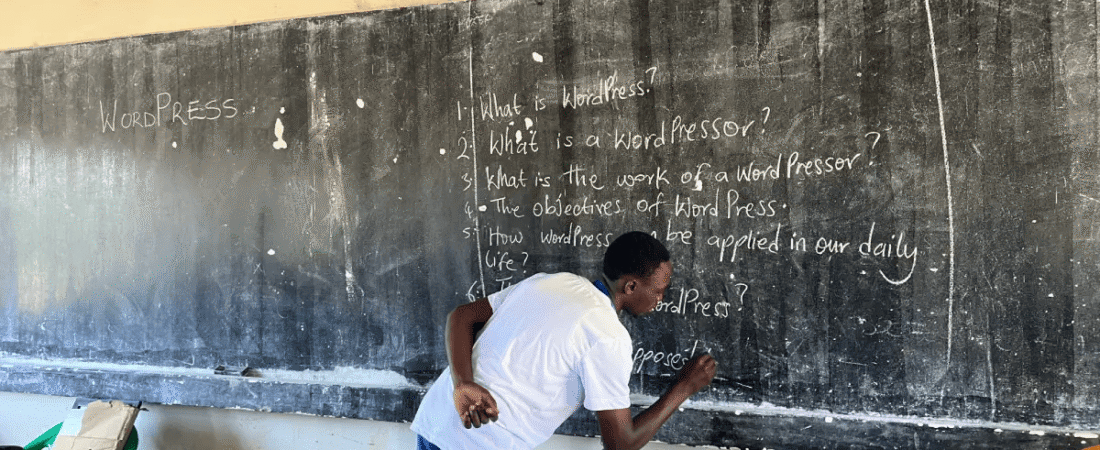
The reported result is specific. In July, students at two campuses in Kishoreganj built 108 websites, according to the supplied primary source. The same source says a workshop in eastern Uganda continued despite having no electricity at the school and reached more than 100 learners.
The source also reports that three university students in Costa Rica taught a three-session WordPress class to 40 people. These are the locations, learner counts, and workshop outcomes established by the case study.
Several useful details remain unreported. The case study does not establish the quality of each website, the exact curriculum, the time spent with each learner, or whether the sites remain online. It also does not say whether students learned custom code, accessibility testing, hosting, analytics, or client handoff.
That boundary matters for enrolment decisions. The number supports a claim about reported production during a workshop. It does not support a claim that 108 professional websites were completed.
What 108 websites in two weeks means for students
A large output can show hands-on activity. If you are comparing short courses, a record of finished projects may suggest that the programme includes practical work rather than lectures alone. It still does not tell you whether the projects match your goals.
Ask to see one or two finished examples before enrolling. Inspect whether each site has a clear purpose, readable content, sensible navigation, and a layout that remains usable on a phone. Those are checks for your decision, not claims about every website reported in Bangladesh.
You should also ask what part of the work belongs to the learner. If every participant follows one identical template, the sites may show completion without showing much individual judgment. If students make choices about structure, content, hierarchy, or layout, you may have more material to discuss in a portfolio.
The questions that reveal course quality
Use these questions to find out what “built a website” means in practice:
- Does every student make something? A lecture about WordPress is different from producing a working site.
- Can students choose a subject or brief? A personal or assigned brief may show more decision-making than a copied demonstration.
- Is feedback included? Ask whether an instructor reviews structure, typography, mobile layouts, content, or accessibility.
- Do students keep the result? Confirm whether you receive the site, design files, written notes, or a public link.
- Is there time to revise? A first version becomes stronger evidence when the course includes critique and a second pass.
These questions do not describe the Bangladesh programme unless the source says so. They are selection criteria for evaluating another workshop before you commit your time or money.
What belongs in a student portfolio?
Portfolio value comes from decisions you can explain. A reviewer may ask what problem a project addressed, who it served, what constraints shaped it, and what changed after feedback. A participation total cannot answer those questions for you.
If an organiser publishes finished examples, review them rather than relying on the headline. Check a page at a narrow viewport, move through the navigation, read the headings without assuming the visual styling is enough, and look for a clear purpose.
Then ask whether you would be able to explain the work yourself. Could you describe why the page is structured that way? Could you identify a change made after critique? Could you show what you learned rather than only showing that you attended?
Is a two-week format enough?
The case study shows that a concentrated workshop can report a substantial amount of learner output. It does not show that two weeks guarantees a portfolio project. For a student, the schedule is useful only if it leaves room for making, feedback, and revision.
The supplied source does not say that the Kishoreganj workshops used a specific brief-to-critique structure. Treat that structure as a criterion to verify, not as a description of the programme.
Ask what happens after the first publish. If the course ends as soon as a homepage appears, you may have evidence of participation. If you receive critique and time to make a second pass, you may have stronger material for a case study.
Who should consider this kind of workshop?
This format may suit a student who needs a first project, wants to practise making a web page, or is testing whether web design interests them. The WordPress.org examples also show that workshops can take different forms, including a three-session class in Costa Rica.
Do not treat a short workshop as evidence of mastery unless the programme explicitly teaches and assesses the areas you care about. If accessibility, hosting, performance, analytics, custom code, or client handoff matter to your next step, ask how each area is covered and assessed.
Use the headline as a prompt for better questions. Before signing up, request one finished student example and ask what support follows the first version. If the organiser can explain the curriculum, feedback process, ownership terms, and revision time, the workshop may be a reasonable way to create an early project.
Sources
- Students Built 108 Websites in Two Weeks in Bangladesh — WordPress.org, published September 7, 2026. This primary source supports the reported workshop locations, learner counts, and website total.
2014 ready-to-use AI prompts — organised by discipline and category, each copyable in one click, free and no sign-up needed. Browse the prompt library →