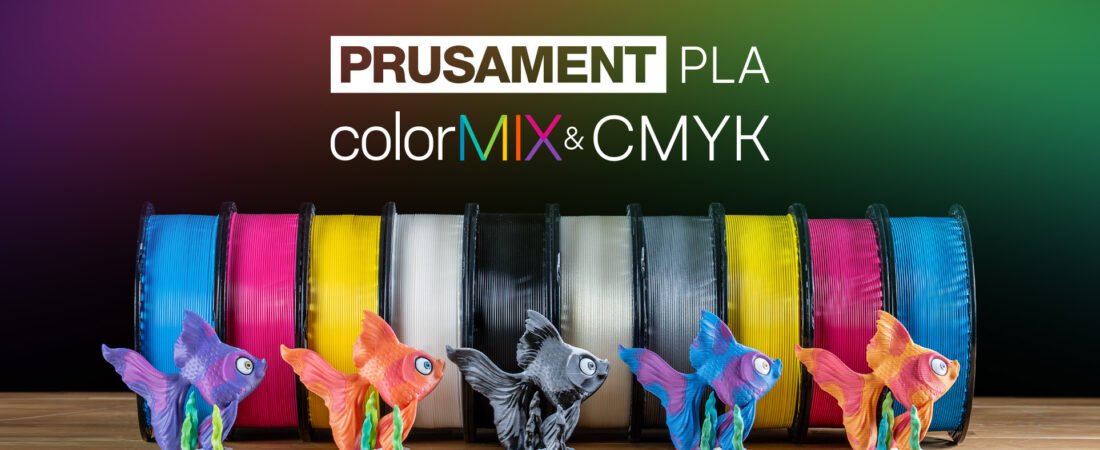
Prusament PLA ColorMix promises 45 color shades from five filament spools. For an industrial designer deciding whether to test the bundle, that is a useful starting point—but it is not a complete color-management claim.
The official Prusa announcement describes an open-source color-mixing model and a dedicated filament bundle. It does not establish that every shade matches a specified production color, so the practical decision is narrower: can this palette support a particular prototype or CMF study?
What we verified
Prusa’s announcement supports the palette and material claims, not a production color guarantee. Prusa says Prusament PLA ColorMix is based on the community project Full Spectrum. It also says the model is open source and that Prusa developed and tested the dedicated bundle before releasing it.
- Five spools are the stated input: the bundle is designed to produce a broader palette from five filament colors.
- Forty-five shades are the stated output: this is the announced range, not a promise of every possible color.
- The mixing model is open source: the project provides a reference for the approach behind the palette.
- A dedicated bundle is available: Prusa presents it as the practical material set following the earlier model work.
Those are the claims supported by the supplied source. The announcement does not provide a measured colour tolerance, a production colour-matching guarantee, or evidence that the system works identically across every printer and slicing workflow.
Prusament PLA ColorMix: what the five-spool claim changes
The strongest reason to test ColorMix is palette management. If a project needs several visual directions, five source spools may be easier to organise than a separate spool for every desired shade. That is a reasonable workflow hypothesis based on the announced input and output, not a performance result reported by Prusa.
For industrial designers, the relevant test should be tied to a real project. Choose a model where colour is part of the design question, then check whether the announced range includes useful options for that model. Do not treat the number 45 as proof that all 45 shades will matter to your current brief.
The open-source model may also matter if you need to document how a shade was produced. The announcement confirms that the model is open source, but it does not explain a complete record-keeping process. Keep the mix information, source spools, and print settings with the sample if repeatability matters to your review.
The colour question Prusa’s announcement does not answer
A shade count is not the same as a colour tolerance. Before adopting the bundle for a client-facing prototype, print a small set of the shades that your project actually needs. Compare them under the lighting used for design reviews.
Test the geometry that matters. If the project uses a flat badge, a curved housing, and a small control detail, print representative samples rather than relying on a single swatch. This is a recommended check, not a claim about how ColorMix behaves across different forms; the supplied announcement does not report that result.
Also separate prototype exploration from production approval. The source establishes a filament palette and a mixing model. It does not say that ColorMix delivers a specified production finish or a guaranteed match to a brand colour, so those requirements need a separate check.
Who should test it first?
Industrial designers exploring colour directions have the clearest reason to run a small trial. The bundle is relevant when a project needs several shades and the team wants to evaluate whether five filament inputs can cover the brief.
It is a weaker fit if the first requirement is a documented production colour match. In that case, test the specific target colour and approval process rather than judging the material by its headline shade count.
This distinction matters during reviews. A palette can be useful for comparing form, proportion, contrast, and colour direction without being suitable for a final approval sample. Label the samples accordingly so an exploratory result does not get mistaken for a manufacturing reference.
A practical first test
Keep the trial small enough to answer one design question. A useful test is not an attempt to reproduce every shade in the announcement. It is a controlled check against the needs of one current project.
- Pick one real prototype question. Define the colours you need before printing.
- Use matching sample geometry. Print the same form for each candidate shade.
- Include the surfaces that matter. If the final concept has a curved shell and small controls, include both in the sample set.
- Review under working conditions. Use the lighting and viewing distance relevant to the design review.
- Record the result. Keep the five-spool recipe and print information with the samples.
- Separate approval levels. Mark whether each sample supports exploration only or is suitable for a later validation step.
That process does not prove a universal result for ColorMix. It gives the industrial designer a project-specific answer, which is more useful than relying on the headline number.
The practical verdict
Prusament PLA ColorMix is worth testing as a compact exploration palette. The announced 45-shade range gives industrial designers a clear reason to investigate when a project needs several colour directions from a limited set of filament inputs.
The limitation is just as clear. The supplied announcement does not establish production-level colour matching, repeatability across all setups, or suitability for a particular approval standard. Treat the bundle as a material to evaluate against a real prototype brief, not as proof that colour validation is solved.
Start with three to five shades that answer a current design question. If the samples support the review, keep the recipe and conditions with them. The open question—how consistently the shades meet your own colour and surface requirements—should remain part of the test.
Sources
- Prusament PLA ColorMix: Print 45 color shades using just five filament spools (and more) — Prusa Research, September 8, 2026.
2014 ready-to-use AI prompts — organised by discipline and category, each copyable in one click, free and no sign-up needed. Browse the prompt library →