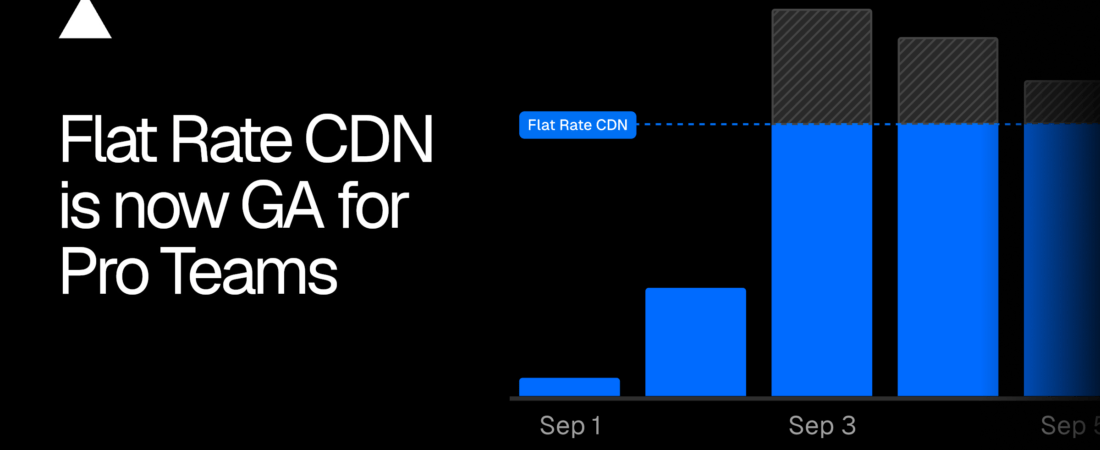
Vercel Flat Rate CDN is now generally available to Pro teams. For an agency, the interesting part is not simply that the bill can be fixed. It is that the capacity decision applies at the team level, which makes the team boundary part of the budgeting decision.
That raises a practical question: should an agency consider this for client work, or keep usage-based billing? Vercel’s announcement establishes the new option. Your own account and project mix must decide whether it fits.
What we verified
Vercel’s official changelog says Flat Rate CDN is generally available for Pro teams. The announcement describes it as an alternative to usage-based CDN billing with a fixed monthly bill.
Vercel also names the capacity categories included in the model: fast data transfer, blob data transfer, CDN requests, and observability events generated by CDN requests. Capacity is set at the team level, and spike protection is enabled by default.
Those are the product facts this article relies on. The announcement does not establish what will be cheapest for a particular agency, how each client project should be grouped, or what a specific account’s capacity should be. Treat those as questions to check in your own Vercel account.
Why the team boundary matters
Team-level capacity changes how an agency should frame the decision. Instead of looking only at one client site, you need to identify the projects covered by the same Vercel team and understand that the announced capacity scope is the team.
That may suit an agency whose client projects are intentionally managed together. It may deserve more scrutiny if the team contains unrelated clients, separate contracts, or projects with very different traffic expectations.
Here is the safe planning interpretation: the team structure is a decision variable. Before changing billing, document which client sites belong to the team, who controls the account, and whether the people responsible for those projects can review the same capacity information.
This is agency operating guidance, not a claim about how Vercel allocates traffic between projects. The changelog confirms team-level capacity. It does not describe a project-by-project allocation method or tell you what happens to an individual site when the team approaches a limit.
Vercel Flat Rate CDN versus usage-based billing
The verified distinction is the billing model. Flat Rate CDN uses a fixed monthly bill, while the existing alternative is described by Vercel as usage-based CDN billing. The changelog also identifies the capacity categories and the team-level scope.
| Dimension | Flat Rate CDN | Usage-based CDN billing |
|---|---|---|
| Use case | A team considering a fixed monthly CDN bill | A team using Vercel’s usage-based CDN billing |
| Price model | Fixed monthly billing | Usage-based billing |
| Capacity detail | Vercel names fast data transfer, blob data transfer, CDN requests, and observability events generated by CDN requests | The supplied announcement does not detail a separate capacity allowance for this model |
| Scope | Capacity is set at the team level | The supplied announcement does not specify a comparable team-level scope |
| Protection detail | Spike protection is enabled by default | The supplied announcement does not describe the same setting |
| Agency question | Does the fixed model fit this team’s projects and budget process? | Does usage-based billing remain easier to justify for this team’s work? |
The table separates what Vercel states from what an agency must decide. It does not prove that either option costs less. Pricing and capacity can only be assessed against the figures available in your account. This article was prepared in September 2026.
Three checks before changing the billing model
1. Define the Vercel team boundary
Write down the client sites and other projects managed by the relevant Vercel team. Include the internal owner and the people who need visibility into billing.
Do not start with an abstract monthly target. Start with the actual account structure. If two clients are managed under one team for convenience, ask whether that arrangement still makes sense for a team-level capacity model.
2. Match the account data to Vercel’s named categories
Review the information available in your account for fast data transfer, blob data transfer, CDN requests, and observability events generated by CDN requests. These are the categories named in the announcement.
Then mark the periods your agency considers sensitive, such as a campaign launch or a planned client release. This does not predict how Flat Rate CDN will behave for your account. It gives you a more useful comparison than looking at a single average month.
3. Confirm the spike-protection details
Vercel says spike protection is enabled by default. Before making a client-facing promise, read the current account information and confirm what that protection means for the capacity option you are considering.
Do not turn “spike protection” into a guarantee about unlimited traffic. The supplied announcement confirms the setting but does not provide enough detail here to describe its thresholds, duration, or billing consequences.
Who should evaluate it first?
Flat Rate CDN is most worth evaluating for an agency that has a clear Vercel team structure and a real need to compare a fixed monthly bill with its current usage-based arrangement. That is a narrower recommendation than saying every agency should switch.
Agencies with several client projects should also decide who owns the choice. A developer may inspect the technical account, while an account lead or finance owner may need to approve the recurring commitment. Keeping those roles clear prevents a billing change from being treated as a purely technical setting.
The sensible next step is a controlled review: identify the team boundary, inspect the four named capacity categories, confirm the current Flat Rate CDN terms, and compare that information with your agency’s budgeting process. If the figures and scope make sense, you have a basis for further evaluation. If they do not, the announcement alone is not a reason to change billing.
Sources
2014 ready-to-use AI prompts — organised by discipline and category, each copyable in one click, free and no sign-up needed. Browse the prompt library →